Sunday, December 18, 2011

Spaghetti Squash!


By Ciara Cappo

Last month I set a goal for myself to eat healthier and clean up my diet. I set this goal for myself in order to have a healthier lifestyle. Sometimes we can go day to day and not realize how much the things we put in our mouth affect our body. The things we consume can affect our bodily functions, energy and mood. One thing you should take notice of when changing your diet is how your body feels and if there are any changes that occur with your body during this time. I have become more aware of how my body feels since changing my diet, when eating certain things I have noticed what my body does and does not like. I have noticed that since cleaning up my diet I have felt better and seem to have more energy than before!

 I started my ‘clean’ diet by eating as much fresh fruits and vegetables as possible, chicken and fish, and 

started eating brown rice instead of white. I come from an Asian culture so switching over to brown rice was very difficult for me luckily I found a brown rice and quinoa medley that I like and tastes great! A great tip for making diet and lifestyle changes such as this is to find foods that go along with your change and also taste good. If you don’t enjoy what you are eating, you will be least likely to follow your diet change. Most of the time I have been altering recipes I currently use to incorporate fresh ingredients but the other night I tried a completely new recipe. I made spaghetti squash! I first heard of this recipe from a woman I met while working- she said her granddaughter loved it. I thought to myself “if kids love it, then why wouldn’t I?” At my next grocery store visit I happened to walk past the squash and noticed a recipe sticker attached to it, it was the recipe for spaghetti squash. It was a sign! If you’re lucky enough to find a squash that comes with directions you should definitely try it.

Spaghetti squash was somewhat easy to make. Basically instead of using traditional spaghetti noodles for the pasta, you cook and string the squash to use as noodles. You can add your usual pasta sauce or make your own like I did.
1.     You must poke holes with a fork around the entire squash.
2.     Next you microwave the squash for 8-10 minutes or until the skin begins to soften. Carefully remove squash, cut in half and remove seeds.
3.     Using a fork, scrape along the inside of the squash. This will cause the squash to peel off in a stringy fashion. Do this to both halves of the squash until the desired amount of “noodles” are obtained.
4.     Now you are ready to add your homemade sauce and enjoy!

Here are a few pictures from my experience with this dish


Wednesday, December 7, 2011

What a Great Quarter!


We have just finished up our second quarter as a club and it has been been full of progress. We had very high hopes for this quarter, setting big goals and I have to say that we have made tremendous progress as a group. We have now established a website, serving as a home-base to our organization and have begun to produce educational articles in blog format to further support our mission of reaching out to the online community. We also held The Work Hard Play Hard Fundraiser as one of our many upcoming fundraisers. The event had a great turn out and served as a great way for us to get exposure and funding as an upcoming club. Beginning last week, we launched our own workout program as a club. Each week we will be meeting on a voluntary basis to practice what we preach and get a great workout in! Thus far, it has been a fun experience and we will be continuing this in the future.

And now on to the good stuff...

Three weeks ago, we held our first Healthy Choices Seminar! We got the opportunity to have an awesome time sharing exercise and nutrition with 15 kids at San Jose Family Supportive Housing. The event was such a great experience for all of us and we learned a tremendous amount from the hour we spent there. We are incredibly excited to have the chance to return there in the future and implement our program in many other locations throughout The Bay Area.

We have taken some huge steps in the right direction in the last 10 weeks and we don't plan on stopping by any means. We have many more goals set for the upcoming quarter and have seminars lined up for the new year. I can't wait to see how much our club will grow in the coming year. Thank you all for your support, we appreciate all that we have recieved and are excited to continue our efforts in changing The Bay Area for the better!

Monday, November 28, 2011

The Need For Research

By: Jaclyn Casab


I have a degenerative disease in my spine, called Diffuse Idiopathic Skeletal Hyperostosis (DISH), which makes me somewhat of an anomaly since the typical patient is male and over the age of 50, while I am female and only 31.  Besides the drawback of having a degenerative disease in the first place, the greatest challenge has to be the lack of knowledge and research pertaining to DISH.  I have found that many, even experienced clinicians, do not understand what it is.   The danger in that occurs when they try to associate it with other diseases such as ankylosing spondylitis and degenerative joint disease, since the diseases are found within the same category of degenerative diseases.  That is where the similarities end though, in that the treatment of patients with DISH is unique because while the other degenerative diseases cause breakdown of the joints in some way or another, DISH only affects a ligament called the ALL on the front of the spine and has nothing to do with the joints themselves.  Most likely, this is not due to the fault of the doctors trying to treat patients with DISH, but rather due to the lack of research, especially in the way of treatment courses and in the areas of diagnosis and potential causes.  The need for research is so important for people in my situation because when DISH is lumped into other categories, the tendency is for doctors to recommend the opposite of what I need and want to make me feel better, which should be the focus.  Staying as flexible as possible by staying active and stretching, which, based on my personal experience, is an excellent recommendation for the management of DISH.    Additionally, I am curious as to how many people out there may have this disease and not even know it because no one has ever looked for it.  Who knows, maybe I am not an anomaly but instead, an overlooked population waiting to be discovered.  It was only by accident that it was even found because I did not need x-rays; I just thought they would be cool to look at.   Therefore, I would strongly recommend keeping an open mind, and for doctors treating and patients with DISH to document their findings whenever possible.

Sunday, November 13, 2011

Squat Low and Often

The fitness industry has brought us millions of different “miracle” exercises, workout plans, machines, and yet as many fads have come and gone within the world of exercise; one movement has proven its worth as the ultimate functional tool, that movement being none other than the squat. This exercise proves to be the single best, and simplest tool for developing functional movement for many reasons and we will cover a few in this post. One of the most important of these is the fact that it is engrained within our neuromuscular system from the first time that we stand up as infants. If you take a look at the video below, you will see a perfect demonstration of an air squat performed by a toddler as he stands up for the first time.


As we develop into our adult form, our bodies adapt to the environment that we chronically place ourselves into. We currently live in an era in which sitting predominates our lifestyles and this causes an array of issues. We suffer the effects of poor posture and lack of movement through tight hips and a weak posterior chain within our bodies. When we lose the suppleness, strength, and elasticity of our bodies to perform complex posture-oriented movements such as the squat, we lose our ability to perform simple tasks like picking up objects without injury, standing up off of the floor, sitting down into a chair, etc. The bottom line is that training proper squat technique allows us better movement and function.

The importance of not only squatting; but, squatting deep is pivotal with what we are trying to accomplish through our exercise program. Squatting deep and often has been shown to increase posterior chain activation as opposed to squatting down to 90 degrees. Shallow, or half squatting has been shown to place stress and activation within the quadriceps. This is not necessarily a bad thing; but we at The Kidnetics Project prefer movements that give us greater “bang for our buck” and want to utilize the squat to not only strengthen the quadriceps; but, also gain access and strengthen the muscles of the posterior chain, which are essential to holding us upright, protecting our lower backs, stabilizing our pelvis, running, jumping, and keeping us stable during everyday movements.

For further research on this you may refer to a study performed by Caterisano et al 2002 which provides valuable insight into squat depth and muscle activation. In this study, the researchers found glute activation during full squats to be greater than twice that of partial squats (35.4% compared to 16.9%), hamstring and adductor complex activation to be similar, while quadriceps activation dominated during the partial squats only.

Posterior Chain Muscles Emphasized:

· Hamstrings complex
· Gluteus Maximus
· Erector Spinae
· Latissimus Dorsi
· Trapezius – lower, middle, upper
· Rhomboids

Squatting with an added load or weight in the front or back also provides an even greater activation of core stabilizers and overall muscle recruitment. This is a topic that will be addressed in future posts.


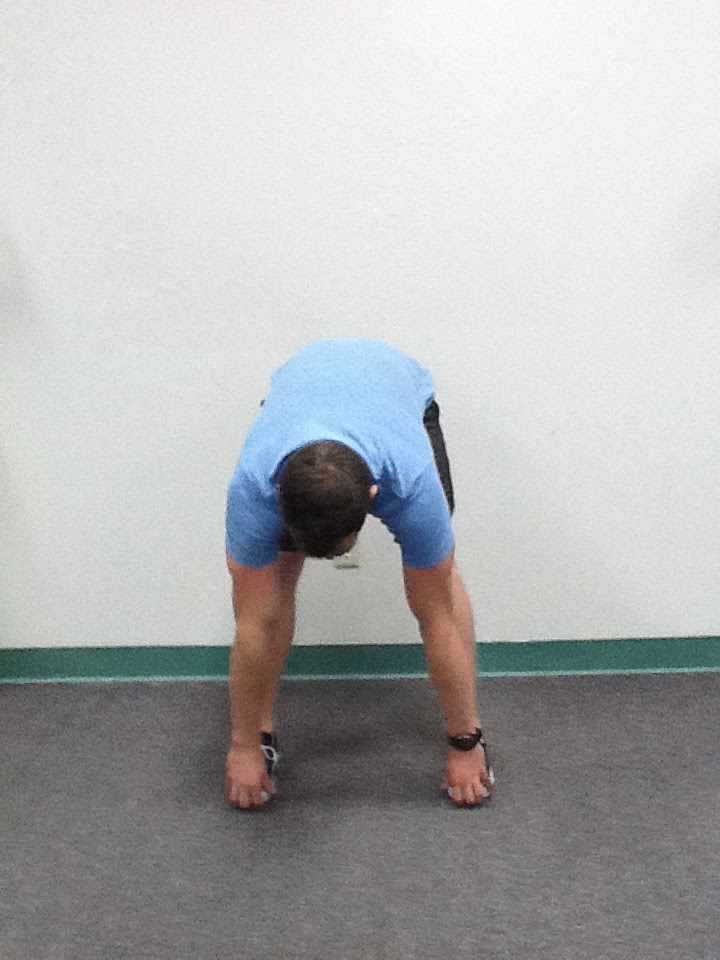
Bottom's Up Squatting:


Where To Start:
  • Stand with feet shoulder width
  • Toes pointed straight ahead
  • Reach down and grab toes or low barrier with hands
  • Keeping heels down and hands on feet, descend to bottom of squat
The Bottom of The Squat:
  • Hips should descend below the knees
  • Knees should be in line with 2nd and 3rd toes
  • Heels should be down
Standing back up: 
  • Release hands from toes
  • Reach arms straight up
  • Pull torso upright and brace abdomen
  • Stand up driving heels down and knees slightly out

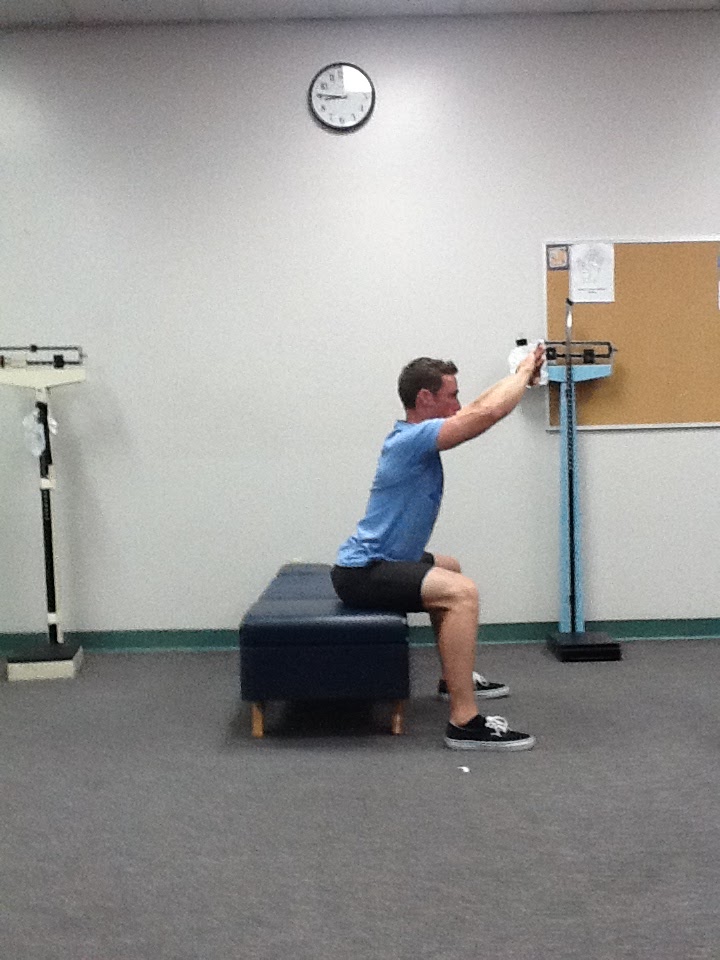
What’s that you say? You have chronic knee problems from past injuries? Have no fear, the squat can easily be modified to provide the same effect in a stable environment for those of us with knee trouble. This modified squatting exercise is called “The Box Squat” and reduces the sheering effect on the knees by preventing the knees from traveling forward.


The Box Squat: 


Where to start:
  •  Place a box behind you just like you would a chair 
  •  Set your feet outside of shoulders 
  •  Turn feet out slightly 
  •  Stand tall 
The Descent:
  •  Begin the squat by first kicking your butt back as if to close the car door with a handful of groceries 
  •  Continue this hip motion and begin to passively let your knees bend 
  •  Do NOT let your knees come forward 
  •  Instead, drive them out in line with your toes 
  •  Allow your torso to fold forward as you squat down to the box 
  •  Keep your core tight and back flat 
  •  Descend all the way down to the box 
Standing back up:
  •  After touch the box drive through your heels pulling your butt up first 
  •  As you do this pull your chest up simultaneously 
  •  Do NOT let your knees come forward 
  •  Stand completely upright locking your knees and squeezing your glutes 

There it is! Two variations of the squat for you and we’re only one post into this madness. More to come on variations of loaded squats and how to incorporate the same concepts in other movements. Until then, squat low and squat often my friends!

Thursday, November 10, 2011

New Shirts!


The new shirts are in and they are AWESOME! Come and pick yours up if you ordered one and please let us know via email if you would like to order one and we will get one for you in the next order we place.

Tuesday, November 1, 2011

Water


By Nichelle Francavilla

Our Thirst for Water
If you are drinking anything besides plain water and thinking you are doing a great job getting your daily requirements, think again. You need to be drinking half your body weight in ounces a day. This means if you are 120 lbs you need 60 ounces or 7.5 cups of water a day or more. But the question remains, why do we need water?


Let’s break it down:
Our bodies are made up of 50-80% water depending on age and is used in nearly every bodily function. The essential role of water is why we need to main a healthy ratio within our bodies. There is a significant amount of water in our blood, brain, lungs, and muscles. The water in our bodies help us regulate temperature and help with the transport of nutrients throughout the body. Drinking water also helps with cleansing and detoxifying, digestion and metabolism, replacing fluids after exercise, enhances fat loss, and hydrates skin. Overall, water is critical to our survival because of all the vital functions water has within our body.

Wait… so soda doesn’t count as water?
 It is important for our bodies to receive water by itself because drinks such as soda and alcohol actually take water from the body and drinks such as coffee, milk, and juice require water to help with digestion.


What to do to increase your water intake?
It’s smart for both children and adults to carry around a water bottle with them to get in the habit of continuously drinking water. By using a water bottle you can easily see how much water you have been drinking throughout the day and can help create goals for yourself until you reach the correct amount of consumption. There are some people who get tired of plain water and for those people it is okay to add a little lemon for flavor (but note that drinking lemonade is not the same). If you are thirsty this is your body’s signal that you need water intake and that you are on your way to dehydration. Also, if your pee is dark yellow then this is usually a sign that you should drink more water. 

Thursday, October 27, 2011

Making Lunch Count

By: Tomilyn Thornberry

Now that the school year is in full-swing it’s possible that as we get busier, whether as students or parents when it comes to packing lunches it’s easy to just throw together the most accessible thing in our pantry into our bag or the kids’ lunch boxes. Busy schedules somehow tend to take over and we forget that what we eat for lunch is important, especially at the midpoint of the day when our brains and bodies need a boost.

I was a middle school teacher for 2 years and it was always tough for me to see kids bring lunches that included nothing but white bread and sugary jelly, chips, high-sugar “juices” and fruit snacks. I even had a student who brought nothing but a Ziploc full of marshmallows for lunch one day! While it may be convenient to stuff a brown paper snack with a plethora of pre-packaged empty carbohydrates kids and adults alike are, in my opinion, better off not even eating lunch than eating empty calories with no actual nutrients. Coincidentally, many of my students that brought some of the aforementioned items were also those that demonstrated a noticeable slump in mental coherence and mood during afternoon classes. Studies show that children who eat diets rich in fiber and protein perform better in school than those who consume diets low in protein and high in sugar.  Not only does protein and fiber take longer to digest than high sugar foods, but they also supply essential amino acids that combine to form proteins that are essential for managing the neurotransmitters in the brain.  I’ve had parents ask me during parent-teacher conferences for suggestions with helping their child “focus” and I always told them that in my opinion the best place to start is with what you feed your body ( and therefore ,brain.)

Healthy school lunches, especially in the public school sector is a topic that is as broad as it is long so much so that professional chefs make TV shows about it (i.e. Jamie Oliver’s Food Revolution) and state and federal legislature is continuously fighting battles over it. My only attempt here in this post is to point you towards some ideas of simple ways to incorporate brain-and-body-boosting foods into noontime meals. It doesn’t mean you can’t throw in a bag of Sun Chips or a pack of fruit snacks into your or your child’s lunch but the meal can’t rest on those things. Your body and especially those of children need protein, vegetables, fruit and healthy fats to get through the afternoon slump. It’s actually amazing how easy it can be to switch out “go-to” items that lack nutrients with much more fortifying options. Sometimes we just need some hints! So whether you are packing a lunch for yourself, your spouse or your children here are a few links with some clever tips on making lunch count! (Oh and use your Tupperware!) Happy eating!

Links:
http://www.jamieoliver.com/us/foundation/jamies-food-revolution/bestworstlunch

- For those that need visual aids here are some pictures from a website called This Lunch Rox (www.thislunchrox.com) .

This lunch includes:  peanut butter roll-up, cucumbers, almonds, strawberries and blueberries, chewy chocolate granola bar


This lunch includes:  turkey/spinach/cheese wrap, strawberries, celery & p.b. (if peanut allergies are a concern you could use hummus instead), peanut butter-dark chocolate muffins, trail mix 


This lunch includes:  cheese & onion quesadillas on flax seed tortillas, salad with ranch dressing, strawberries/kiwi, flax seed taco chips, brownie


Today’s quick-and-easy lunch includes:  egg salad sandwich, plum, broccoli and ranch dip, chocolate granola bar, spelt pretzels and cheese